
There is a different, quiet exhaustion that sets in around 11:00 pm. The house is completely silent, the kids are asleep, and your work laptop is finally shut after a gruelling 9-10-hour day of corporate firefighting. However, your night is just beginning. You open a blank document, blink against the glare of the screen, and prepare to dive into 3-4 hours of quantitative research methodologies.
For a new generation of go-getting professionals, this is the reality of chasing a terminal degree. For decades, earning a doctorate required an enormous sacrifice: you resigned from your job, packed up your belongings, moved to a university town, and lived on a meagre stipend while teaching undergraduate classes.
It was a reclusive commitment. Today, that old dynamic has been totally disrupted. Mid-career professionals worldwide are looking at online doctorate programmes as a golden opportunity, a way to secure the coveted “Doctor” title, unlock top-tier executive roles, and pioneer industry-shifting research, all without missing a single paycheck.
But then again, as the market for advanced online & distance education explodes, a critical question divides the worldwide academic and corporate worlds: Is the part-time, flexible doctorate a groundbreaking equaliser for modern professionals, or an expensive, high-risk gamble?
A Degree Built Around Your Calendar, Not the Other Way Around
Doctorate education used to run on one clock: an academic one. You showed up on campus, sat in seminars, and organised your life around your supervisor’s agenda. That model still exists, but it’s no longer the default path for working adults.
Today’s online doctorate programmes are progressively designed around people already deep into their careers rather than fresh graduates. Research into doctorate in management puts the typical candidate in their late 30s to mid-40s, carrying well over a period of work experience, frequently already in mid- or senior-level roles.
Part of what’s made this possible is a wider change toward remote graduate study in general. Recent industry tracking of graduate enrolment found that completely online formats now account for close to half of all graduate study, a share that has silently surpassed traditional classroom-only enrolment in numerous regions. Doctorate education is just the latest, and debatably the most demanding, level to catch up to that change.
And the appetite for it is international, not just a US trend. Surveys of doctorate programmes show these professional-track doctorates now operate across Europe, North America, and Asia in equally comparable numbers, with most having launched only in the past 10 years. More significantly, a big majority of programme leaders surveyed report that worldwide demand keeps climbing, with some of the toughest momentum coming from Asia, the Middle East, and Africa. This isn’t a niche experiment anymore; it’s a significant reshaping of who gets to pursue doctorate study and how.
The Revolution: Why Working Professionals are Buying In?
According to the World Economic Forum’s Future of Jobs Report 2025, almost 39% of workers’ existing skills are expected to change or become outdated by 2030, making continuous learning one of the strongest drivers of long-term career development. Rather than relying exclusively on short-term certifications, numerous professionals now seek advanced academic qualifications that strengthen both expertise and trustworthiness.
Professional development has become progressively dynamic. Organisations no longer value experience alone; they also look for evidence of advanced thinking, research aptitude, strategic leadership, and the ability to solve complex problems. This changing landscape has encouraged several experienced professionals to pursue doctorate qualifications later in their careers.
Unlike traditional doctoral pathways, modern online doctorate programmes make it possible to continue earning an income while pursuing advanced academic achievement. Now, experienced professionals frequently manage demanding workloads, leadership responsibilities, family commitments, and international collaborations. Returning to a campus full-time may just not be practical.
Online doctorate education addresses these challenges by allowing learners to:
- Study from any location.
- Access research resources digitally.
- Learn through flexible schedules.
- Continue professional responsibilities alongside academic work.
- Collaborate with supervisors and peers virtually.
Technology has meaningfully transformed doctorate learning. Video conferencing, virtual libraries, cloud-based collaboration tools, and digital research platforms have created learning experiences that were unimaginable just a decade ago. For many professionals, flexibility is no longer an added benefit, it is a necessity.
Now, the Honest Part
Here’s what a lot of programme brochures won’t put front and centre: doctorate study is genuinely hard to finish, whether or not you’re working full-time. Depending on the discipline, roughly a third to half of doctorate candidates in traditional programmes never complete their degree. That figure tends to run even higher, not lower, in completely online formats, mainly because the factors most likely to derail completion, isolation, unclear expectations, and life simply getting in the way, hit harder when there’s no physical campus pulling people back in.
Add a demanding job, a family, and numerous years of part-time study on top of that, and it’s fair to ask whether this is a genuine transformation of education or just a well-marketed way to spend years and a meaningful sum of money on something you’ll quietly stop pursuing by year two or three. A doctorate develops skills that are increasingly valuable across industries, including:
- Critical thinking
- Evidence-based decision-making
- Research methodologies
- Leadership development
- Innovation management
- Strategic problem-solving
These competencies help experts contribute at higher organisational levels rather than simply progressing through job titles. The worldwide employment attitude supports this trend. The International Labour Organization projects continued employment growth across knowledge-intensive industries, with snowballing demand for professionals capable of research, innovation, and complex decision-making.
As organisations become more data-driven, specialists who can analyse evidence, develop solutions, and lead organisational change frequently become valuable assets.
The Churn Rate and the Quality Trap
The single biggest risk of part-time doctorate study is attrition. While traditional programmes see drop-out rates hovering around 40-50%, some online institutions see much higher numbers simply because life gets in the way. Without a campus infrastructure keeping you anchored, it takes terrifying self-discipline to write a 200-page thesis after an exhausting day of corporate responsibilities.
Also, the market is flooded with unscrupulous, unaccredited degree mills. If a programme promises a doctorate in 12 months with minimal research requirements, it isn’t an elite education, it is an incredibly expensive certificate that global corporate recruiters will instantly spot and discard.
The Finding: How to Choose Your Path Safely?
Earning your doctorate without leaving your career isn’t a dangerous gamble by default, nor is it a flawless educational utopia. It is an extremely strategic, demanding personal investment in your future.
If you are considering taking the leap, protect your time and capital by running your target programmes through a strict validation checklist:
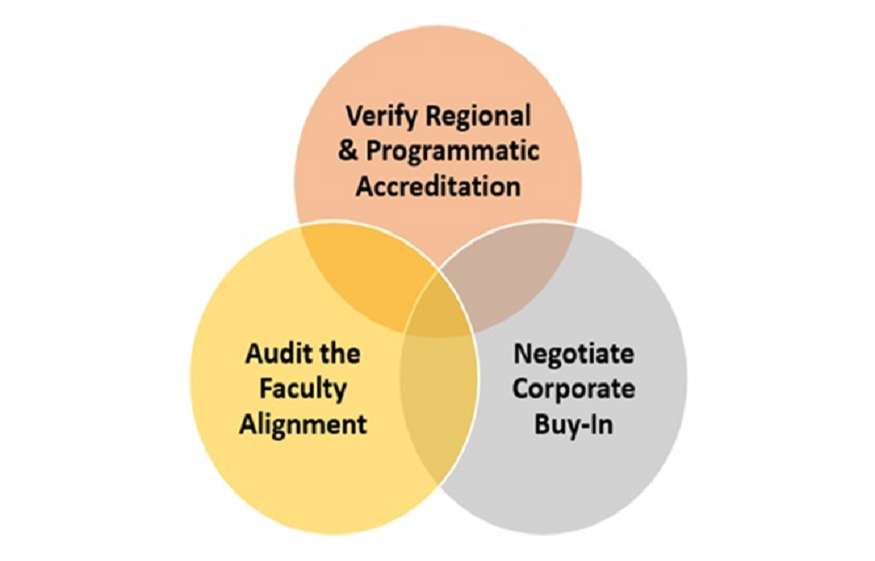
Verify Regional & Programmatic Accreditation: Look for the gold standard of accreditation in your respective territory. If the programme lacks rigorous institutional backing, walk away immediately.
Audit the Faculty Alignment: Ensure that the university’s active professors are publishing related, peer-reviewed work in the exact domain you want to research.
Negotiate Corporate Buy-In: Before you enrol, have a candid conversation with your current manager. Secure their explicit support for your research, and explore whether your organisation offers partial tuition support.
If you possess the inner resilience to manage your time ruthlessly and can find a rigorous, accredited program that aligns with your professional goals, skipping the campus attendance might be the smartest career move you ever make. Just remember to stock up on coffee, you are going to need it at midnight.
So, Is It a Revolution or a Risk?
The answer depends mainly on preparation rather than delivery mode. For professionals expecting an easy qualification, doctorate education can quickly become overwhelming. For those prepared to invest time, curiosity, discipline, and sustained effort, online doctorate programmes can deliver an opportunity to grow intellectually while continuing to build a successful career.
The value of a doctorate has never been limited to the qualification itself. Its greatest strength lies in developing the ability to ask better questions, generate meaningful knowledge, and contribute thoughtful solutions to real-world challenges. For determined professionals determined to keep learning without putting life on hold, pursuing a doctorate while working full-time may represent less of a gamble and more of a carefully planned investment in long-term personal and professional growth.